Fishing rod length
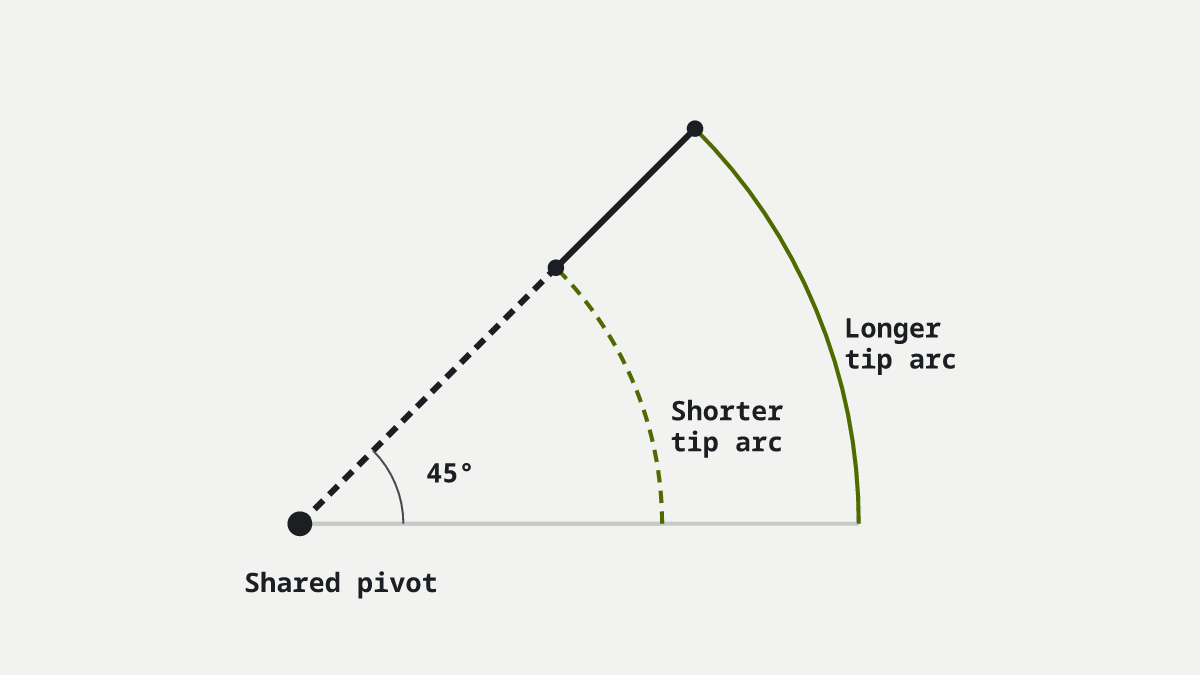
Turn two rods through the same angle and compare how far each tip travels.
Fig. 1 — Same turn, different reach
Geometric model · straight rods · fixed pivotWatch the tip, not the handle
In this model, both rods turn through the same angle from the same pivot. The longer rod’s tip is farther from the pivot, so it travels a longer arc.
The geometry is arc length = radius × angle, with the angle in radians. Here, rod length supplies the radius.
This explains reach and tip travel. It does not predict casting distance or fish-fighting force: real rods bend, hands move, and line and lure affect the cast.
Assembled length and packed length
A ferrule joins sections of a multi-piece rod. Separating them changes what you need to carry without changing the assembled rod’s length.134
Compare the manufacturer’s assembled and packed lengths separately.12 See how telescopic construction differs.
Image version This diagram as a picture, to save or print
What does rod length change?
Rod length changes how far the tip reaches and how much room you need to handle and carry the rod.12 The arc drawing turns rods of different lengths through the same angle from the same pivot, so the longer rod’s tip travels further and reaches further out. Think about the space around you when you cast and the longest piece you can transport, as well as the assembled length.
Sections and packed length
A multi-piece rod joins at ferrules.134 Taken apart, it packs down to its longest section, and sections are not always equal, so read the maker’s packed length rather than dividing by the number of pieces. A telescopic rod slides its sections inside one another instead.
Questions people ask
Sources
First cited on this page- Mud Hole: Understanding rod ferrulesBack to explanation
- Take Me Fishing (RBFF): Freshwater fishing rodsBack to explanation
- Fly Fishers International: Fly Fishing GlossaryBack to explanation