How fishing reels work

Pick a reel and step through the cast, retrieve and drag to see which part turns.

A reel stores line, winds it back in and resists a pull as line goes out (the drag). Spinning and spincast reels cast from a spool that stays still. Baitcast and conventional spools turn; a usual fly cast feeds loose line already off the reel.12345678910

Mechanism lab

Compare reels
Reel state

Trace the line before anything moves.

What turns when line leaves the reel?

What keeps moving while line goes out?

What turns to wind line back in?

Which part yields when the drag slips?

Can the spool feed line faster than it leaves?

4 of 6

Still frame. Play a short demonstration.

Try a prediction

Fig. 1

Spinning reel

SpoolRotor
SpoolRotor
SpoolRotor
SpoolRotor
SpoolRotor
SpoolRotor

Bail closed: line runs from the spool over the line roller and out through the guides. Nothing turns.111

Why it works this way

The closed bail is what keeps line on the roller path; anti-reverse holds the rotor against a pull on the line.111

Bail open: line leaves the fixed spool in coils over its lip. No part of the reel turns.12

Why it works this way

Because the spool is fixed, the cast needs nothing to spin; the coils are why the first rod guide is large.1212

Line keeps coming off the stationary spool as long as the lure pulls; the rotor stays still.12

Why it works this way

With nothing rotating there is nothing to keep feeding line after the lure slows.1314

Turning the handle spins the rotor around the fixed spool; the line roller carries line onto the spool while the spool moves in and out.51314

Why it works this way

The gear ratio is how many rotor turns one handle turn makes; the spool's in-and-out travel lays line evenly.381113141516

A pull stronger than the drag setting turns the spool against the drag and line goes out; anti-reverse holds the rotor and handle.1711

Why it works this way

The spool can rotate as line pays out against drag. During ordinary retrieval, the rotor turns instead.7

No rotating-spool overrun on this cast: the spool stays stationary. Loose or twisted line can still leave in loops and tangle.1314

Why it works this way

The spool does not rotate during a normal cast, so it cannot feed line by continuing to spin. Loose or twisted line can still tangle.489101314

Fig. 2

Baitcast reel

SpoolLine guide
SpoolLine guide
SpoolLine guide
SpoolLine guide
SpoolLine guide
SpoolLine guide

Engaged (thumb bar up): the spool is locked to the gears and holds the line, with the thumb resting on it.3

Why it works this way

Until the thumb bar is pressed, the spool is locked to the gears; only a pull stronger than the drag can turn it.3

Thumb bar pressed: the spool is freed from the gears and spins as the lure pulls line off it.3456

Why it works this way

This is the mechanism that differs from a spinning reel: the spool itself revolves to pay out line.34561314

The spool keeps turning as line runs out. Spool tension and the brakes slow it, which helps keep it from turning faster than line leaves.481718

Why it works this way

Tension acts at the spool shaft; the brake acts on spool speed during the cast. They are separate controls.481718

Turning the handle re-engages the clutch and turns the spool; the level wind walks the line across it.313

Why it works this way

The spool is driven through the gears, so the ratio is spool turns per handle turn here, not rotor turns.34568141516

A pull above the star-drag setting turns the spool backwards against the drag while the handle stays still.3719

Why it works this way

The drag sits between the handle and the spool drive, so the spool can yield without the handle turning.319

The lure has slowed but the spool is still turning: line lifts off in loose loops that pile on the spool.48910

Why it works this way

Three separate checks slow the spool: spool tension, the brake system, and the thumb as the lure lands.34689101718

Fig. 3

Spincast reel

SpoolPickup pin
SpoolPickup pin
SpoolPickup pin
SpoolPickup pin
SpoolPickup pin
SpoolPickup pin

Line runs from the fixed spool under the cover, past the pickup pin, out of the hole in the nose cone.7

Why it works this way

The spool sits inside a cover, so line leaves through the hole in the front rather than straight off an open spool.7

Holding the button retracts the pickup pin; releasing it lets line leave the fixed spool in coils through the nose hole.7

Why it works this way

The spool stays stationary during the cast, so rotating-spool overrun does not apply.71314

Line keeps leaving the stationary spool through the nose hole until the lure stops.7

Why it works this way

The outgoing line passes through the cover opening. The spool does not need to rotate for line to leave during the cast.712

Turning the handle spins the pin head around the fixed spool; the pin catches the line and winds it on under the cover.7

Why it works this way

The pin head is the spincast reel's rotor: it revolves, the spool does not.571314

A pull above the drag setting turns the spool inside the cover and line goes out.7

Why it works this way

The drag lets a strong pull take line against resistance instead of pulling against a locked spool.7

No rotating-spool overrun on this cast. Loose line can still tangle behind the spinnerhead or inside the cover.1314

Why it works this way

Overrun needs a revolving spool.48910

Fig. 4

Conventional reel

SpoolHandle
SpoolHandle
SpoolHandle
SpoolHandle
SpoolHandle
SpoolHandle

Spool in gear: line is held and the reel is ready to wind.1920

Why it works this way

In gear, the spool is linked to the handle, so it turns only when the handle does or when a pull beats the drag.345671920

Free-spool lever set: the spool is released from the gears and turns as the weight pulls line off; the thumb controls it.3469101920

Why it works this way

Releasing the spool from the gears is what lets a revolving spool pay out line.1920

The spool revolves while line pays out. In this example no casting brake is shown; the thumb can control the spool.3469101920

Why it works this way

Nothing in this example slows the spool automatically, so the thumb does the braking.3468910

In gear, the handle turns the spool through the gears; with no level wind, the thumb lays line across the spool.1920

Why it works this way

Ratio here is spool turns per handle turn, as on a baitcaster.38141516

A pull above the lever-drag setting turns the spool against the drag while the handle holds.71920

Why it works this way

A lever drag is set by moving a lever through its range rather than turning a star.1920

In free spool, the spool keeps turning after the sinker or lure slows and loose line lifts off.48910

Why it works this way

A rotating spool can outpace the outgoing line. Thumb control helps; some conventional reels also have casting brakes.489101921

Fig. 5

Fly reel

SpoolHandle
SpoolHandle
SpoolHandle
SpoolHandle
SpoolHandle
SpoolHandle

Fly line is stored on the arbor; the spool turns directly with the handle, usually one turn for one.2223

Why it works this way

Because the handle is fixed to the spool, one turn of the handle is one turn of the spool.2223

No baitcaster-style spool release is shown: this cast uses loose line prepared beforehand and controlled by the line hand.2223

Why it works this way

The line hand releases the prepared line through the guides as the cast unfolds.2223

Line pulled from this reel turns the spool and its attached handle against drag resistance.2223

Why it works this way

Because the handle is fixed to the spool, it turns backwards whenever line leaves the reel.72223

One turn of the handle is one turn of the spool; line winds onto the arbor.2223

Why it works this way

A larger arbor recovers more line per turn without any gearing.14162223

A pull above the drag setting turns the spool outward against the drag; on a direct-drive reel the handle turns with it.72223

Why it works this way

Drag resists spool rotation. On some fly reels the angler can add resistance by touching the spool rim.72223

The cast shown has no free-spool release. Overspin can still occur when line is pulled rapidly from the reel and the pull then eases.2223

Why it works this way

Spool inertia can continue its rotation when the pull eases; drag resists this overspin.72223

fishing line active partdashed = far side or inside

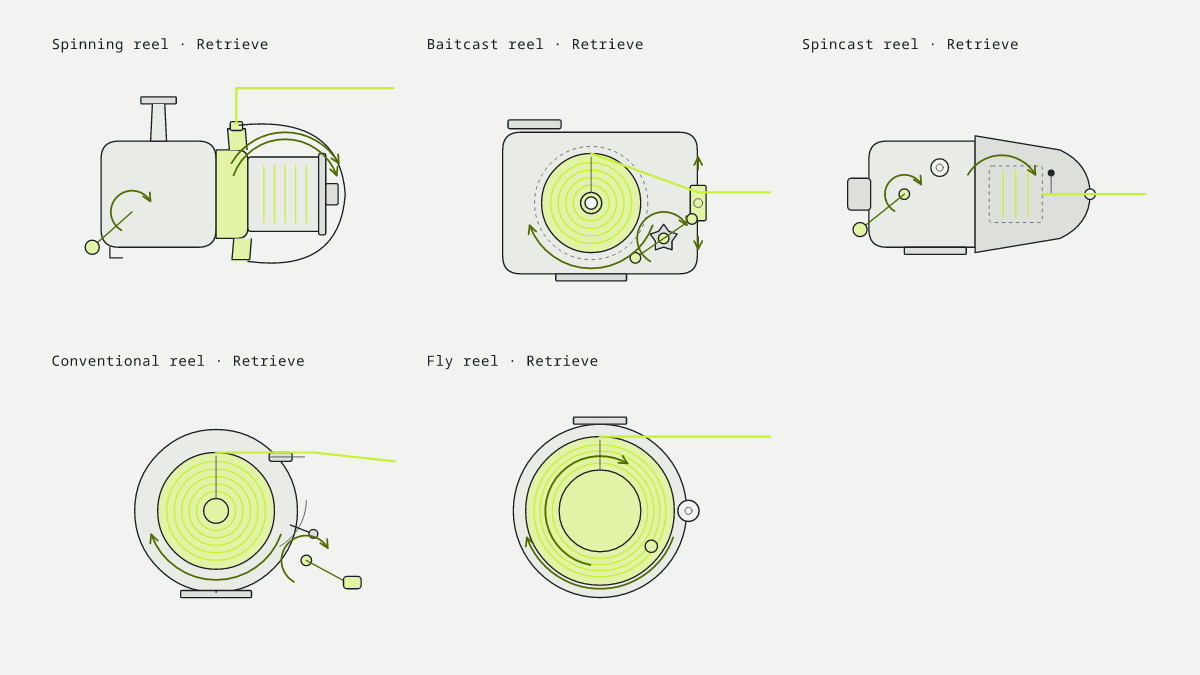
Simplified mechanism examples. Arrows show the direction of motion; sizes and timing are illustrative.

Image version This diagram as a picture, to save or printDiagram of the spinning reel, baitcast reel, spincast reel, conventional reel and fly reel side by side at the retrieve stage, with the fishing line and the parts that move highlighted.

How does a spinning reel work?

On a spinning reel, the rotor turns during the retrieve while the spool slides in and out without turning.51314 When the drag lets line out, the spool can turn too, so “fixed spool” describes casting and winding in. In the lab, start with Spinning and step from Cast to Retrieve, then Drag slips.

How does a baitcaster work?

A baitcaster’s spool turns to let line out, and it can keep turning after the outgoing line slows, feeding extra line into loops.34568910 That is why it has spool tension and brakes.481718 Switch to Baitcast and open the overrun frame to see where the risk comes from, or compare the two layouts stage by stage in baitcaster vs spinning reel.

What the drag does on every reel

The drag lets line pay out against resistance when something pulls hard; a setting that is too high can still let the line break.7 Step to Drag slips on each reel to see which part yields.

The fly reel works differently

In a usual fly cast, the line hand controls loose line already pulled off the reel; the direct-drive reel stores it and winds it back.2223 On this example the handle is fixed to the spool, so it turns whenever line runs out. The types of fishing reels page sets all five side by side.

Questions people ask

How does a spinning reel work?
The handle turns a rotor around a fixed spool; the bail and line roller lay line onto the spool while it moves in and out. For the cast the bail is opened and line coils off the spool lip.1251314
How does a baitcaster work?
Pressing the thumb bar frees the spool so it spins as the lure pulls line off; turning the handle re-engages it and the level wind lays line back across it.345613
How does a fly reel work?
On the direct-drive example, the handle turns with the spool. For a usual fly cast, the angler prepares loose line and controls it with the line hand as it runs through the guides.2223

Sources

First cited on this page
  1. Take Me Fishing (RBFF): Fishing reel parts · accessed Sep 21, 2026
  2. Take Me Fishing (RBFF): How to choose a fishing reel · accessed Sep 26, 2026
  3. Lew's: Speed Spool LSG1HAMG / LSG1SHAMG manual · accessed Sep 26, 2026
All references 23 in total
  1. Lew's: Denny Brauer: how to avoid backlash · accessed Sep 26, 2026
  2. Minnesota Department of Natural Resources (MinnAqua): MinnAqua Leader's Guide, Lesson 5:1 Freshwater Rods and Reels · accessed Sep 26, 2026
  3. Take Me Fishing (RBFF): Tips on How to Cast with Different Reels · accessed Sep 26, 2026
  4. Zebco: Spincast reel instructions · accessed Sep 21, 2026
  5. Wikipedia: Fishing reel (revision 1370480365, 21 Aug 2026) · accessed Sep 26, 2026
  6. Texas Parks and Wildlife Department: A Basic Guide for the Beginning Angler (PWD BK K0700-639) · accessed Sep 26, 2026
  7. Kansas 4-H Youth Development, K-State Research and Extension: Angling Skills (4-H Sport Fishing project) · accessed Sep 26, 2026
  8. Okuma Fishing USA: Tune-Up Tuesday: Anatomy of a Spinning Reel · accessed Sep 21, 2026
  9. Take Me Fishing (RBFF): Freshwater fishing rods · accessed Sep 21, 2026
  10. Shimano North America: Shimano FAQ: rod power and action, series ratings · accessed Sep 26, 2026
  11. Daiwa: How to choose the right spinning reel · accessed Sep 26, 2026
  12. Vermont Fish & Wildlife Department: Casting Rods and Reels · accessed Sep 26, 2026
  13. Sport Fishing magazine (Sam Hudson): High-Speed Saltwater Fishing Reels · accessed Sep 26, 2026
  14. Kentucky Department of Fish and Wildlife Resources (Kentucky Afield column, via Bowling Green Daily News): Kentucky Afield Outdoors: Solving common fishing line problems (23 Jun 2010) · accessed Sep 26, 2026
  15. Zebco: Baitcast reel manual · accessed Sep 26, 2026
  16. PENN: Fathom II star drag: brake and drag specifications · accessed Sep 21, 2026
  17. Penn Fishing: Fathom II lever drag: construction and specifications · accessed Sep 21, 2026
  18. Shimano: Calcutta Conquest A: round-profile baitcasting reel · accessed Sep 21, 2026
  19. Orvis: Battenkill Click reel manual · accessed Sep 21, 2026
  20. Orvis: Shooting and handling line · accessed Sep 21, 2026